
By Bela Patel, Banner Staff
Salvador Dalí was a Spanish artist known for his outlandish imagery and technical skill. Dalí was a pioneer of Surrealism, a movement prominent in the early 20th century that explored the curiosities of the idle mind, usually resulting in incomprehensible and dream-like art. Lila Patel ’30 commented, “A lot of Dali’s creations had a twist on reality and told stories, and that is what made them really interesting,” a description that perfectly summarizes Dali’s use of Surrealism techniques. The current exhibit at the Museum of Fine Arts (MFA), Dalí: Disruption and Devotion, features around 30 of Dalí’s artworks, including his well-known Disintegration of the Persistence of Memory.
I visited the exhibit on October 3 and found it to be both eccentric to the point of unsettling. In one corner of the exhibit, curators juxtaposed four prints from Francisco Goya’s Los Caprichos (1799) series to Dalí’s colorful and Surrealist creations. Goya’s Los Caprichos prints satirically portray several Spanish values and sayings of his time, and Dalí’s Los Caprichos series (1929) showcases the importance of the whimsical and Surrealist influence in his art.
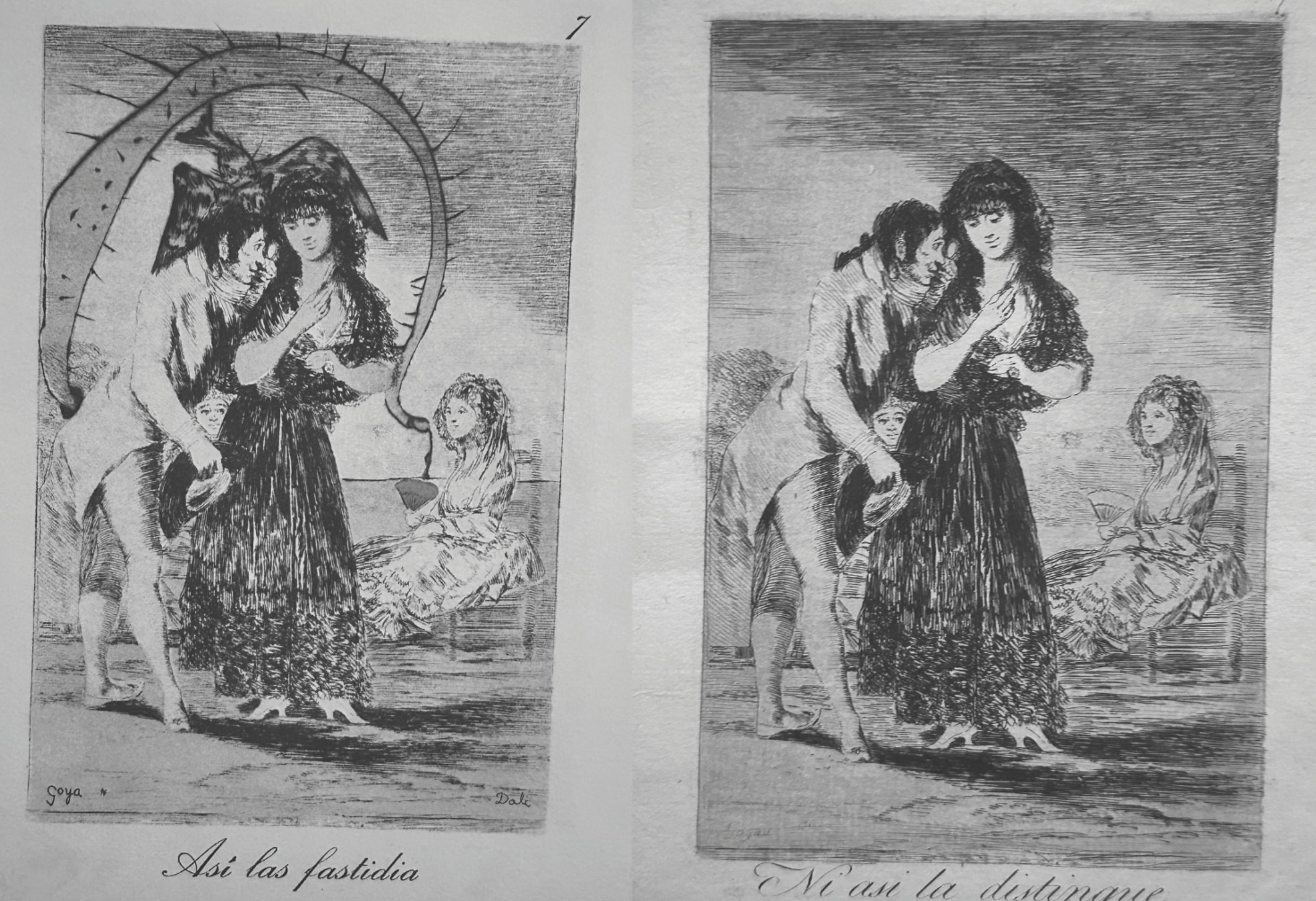
Two Interpretations of Los Caprichos: Photo by Bela Patel
The exhibit also displays Dalí’s The Ecumenical Council, a floor-to-ceiling painting that expresses his interpretation of leadership in the Roman Catholic Church. In 1960, Dalí found hope in religion because of Pope John XXIII’s election in the decade following World War II. The style of this painting is unique, combining Dalí’s beloved Surrealism with painting techniques from the French Rococo art style.
My favorite part of the exhibit was definitely getting the opportunity to learn about Surrealism in Dalí’s art and the historical context that influenced The Ecumenical Council. Elyse Hychong ’26 also visited the exhibit and reflected, “I loved seeing Disintegration of the Persistence of Memory. I had seen the painting online, but when I visited the exhibit in-person, it evoked such strong emotions for me. It was deeply disturbing, but at the same time, I couldn’t look away. The strange combination of objects was disorienting, and the melting clocks suggested the nonlinear nature of time.” The exhibit remains open until December 1; I highly recommend visiting! ☐
 Winsor Banner