
By Leela Uppaluri, Banner Staff
According to PBS, “three in four American adults believe the upcoming presidential election is vital to the future of U.S. democracy.” What exactly makes this election so impactful?
Class VI U.S. History Teacher Mr. Mirelman stressed, “the stakes are high.” Although elections may seem distant to middle and high school students who are not eligible to vote, he emphasizes that it’s important for individuals of all ages to consider their impact. After all, “young people are going to live in a world where policy measures affect their futures.”
As the election nears and tensions rise, so does misinformation. Mr. Mirelman urges students to combat false news by “asking questions, looking at differing pieces of evidence, and applying analytical thinking” when thinking about this political election. Building on Mr. Mirelman’s insights, what factors contribute to this tension, and how do the candidates play a role in it?
Kamala Harris, the current Vice President under President Joe Biden, is the Democratic nominee. Before her vice presidency, she served as a senator in California. Harris was the first Black woman elected as district attorney in California in 2003 and became the first woman, first African American, and first Asian American to serve as California’s attorney general in 2010. She has associated herself with the Biden administration’s accomplishments in economic recovery after the pandemic. However, her critics argue that high inflation and cost of living and rise in illegal immigration are a result of Biden-Harris policies
The Republican nominee, former President Donald Trump, served as the 45th President of the United States from 2017 to 2021. His supporters praise the economic boom of his first two years in office and his “America First” approach, while his critics point to his mismanagement of the COVID-19 pandemic and his authoritarian tendencies. Following his 2020 election loss to Biden, Trump made unfounded claims of electoral fraud, and his rhetoric encouraged the January 6 Capitol attack. In addition, Trump’s presidency was marked by several controversial actions, including a travel ban on citizens from several Muslim-majority countries, military funding diversion for a border wall, and family separation policies at the border. Finally, he faced two impeachments: one in 2019 for abuse of power and another in 2021 for incitement of insurrection, though he was acquitted both times by the Senate.
As the election approaches, several issues are shaping voter sentiment, and four key issues stand out. First, illegal immigration at the southern border remains a controversial issue; Trump’s hardline policies resonate with his anti-immigration base, while Harris advocates for reform and inclusivity although illegal border crossings reached an all time high during her party’s administration. Second, the economy and cost of living are central concerns. Trump calls for tariffs on all imports while Harris hopes to combat inflation by stopping companies from price gouging and increasing home ownership through her $25,000 down payment support for new homeowners. Third, abortion remains a key issue with voters as many see Project 2025, a conservative political initiative that proposes a nationwide abortion ban, to be in line with Trump’s agenda even though he denounces the connection to his campaign. Harris, however, promises to restore Roe v. Wade and pushes for universal reproductive healthcare. Finally, America’s role in global affairs, including its support of Ukraine and involvement in the Israel-Palestine conflict, varies in importance to voters.
A few Harris policies in seem to resonate more with younger voters. One such issue important to Gen Z students is climate change, and as Amelia Kwak ’25, a head of Current Events Club, said, “Climate change will continue to impact our infrastructure and our access to clean air and water” into the future. Trump rolled back over 100 environmental regulations, in contrast to Harris, whose position has largely been to promote regulations that combat climate change.
How can students get involved even if they can’t vote? According to Kwak, “you can volunteer for a campaign by knocking on doors or participating in phone banking or text banking.” Furthermore, both Kwak and Mr. Mirelman emphasized the down-ballot elections’ importance outside of the presidential race. As Kwak noted, there are lots of elections happening besides the presidential election. In particular, there are “Senate, House, and governor’s races” and races for state house, all of which will have an impact on whether the elected candidate can implement the policies they envision.
It’s clear that the upcoming November 5 election is incredibly important, especially given the candidates’ differing views on economic and international affairs, with regard to abortion rights, and even with the democratic process. At the moment, the race is extremly close, and with misinformation readily accessible through social media and AI deepfakes, it remains critically important for Winsor students to be engaged by seeking out the truth and staying informed! ☐
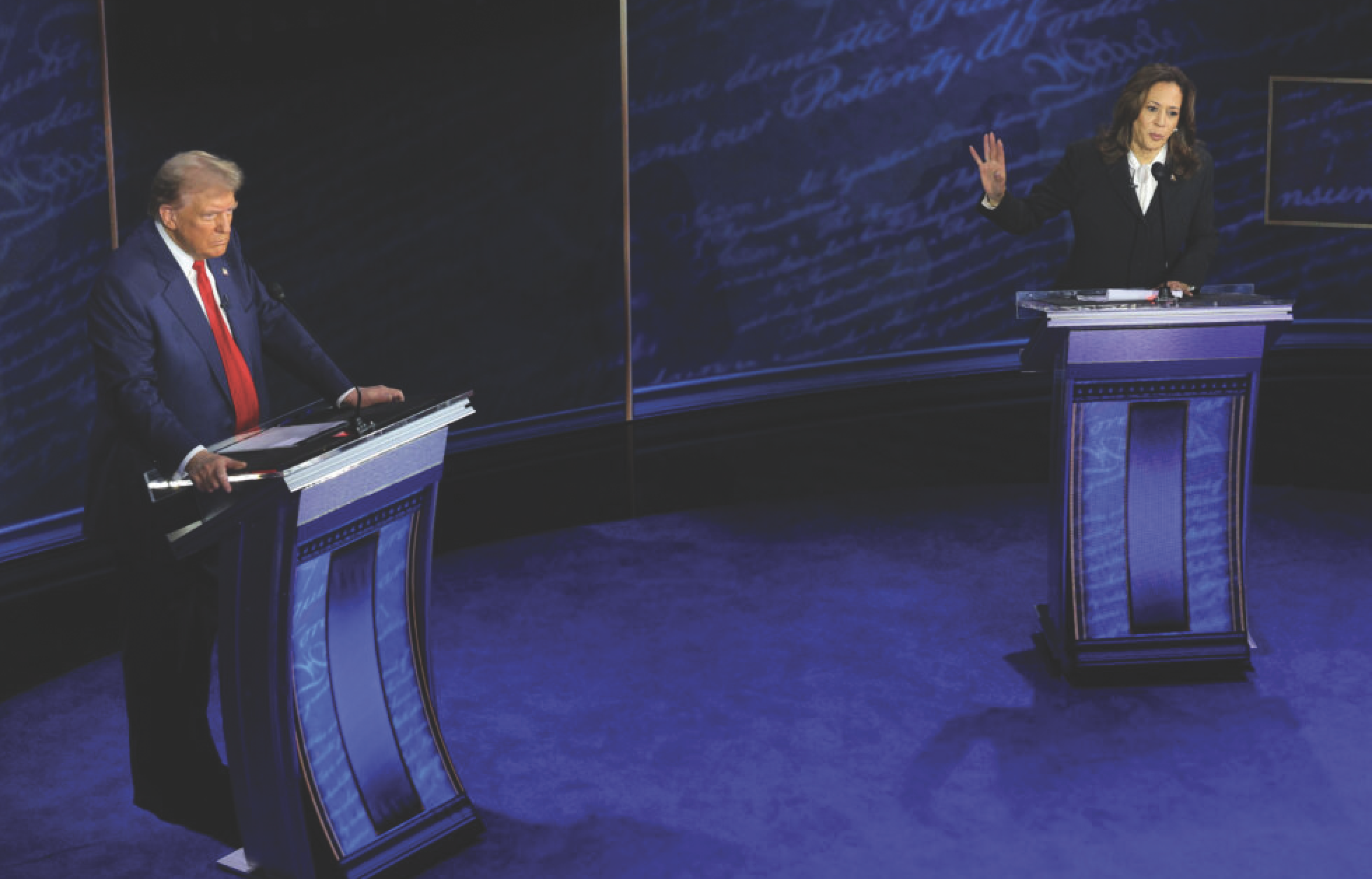
A Presidential Debate Face-Off: Photo from Google Images
 Winsor Banner