
By Nika Bigelow & Ella Paterniti Banner Staff & Contributing Writer
While America experienced a red wave on Election Day, Massachusetts remained securely under Democratic control. Senator Elizabeth Warren (D) was reelected to the United States Senate for a third term, and Democratic representatives were reelected to all nine of Massachusetts’s seats in the House of Representatives.
In the State Senate elections, Democrats won 35 of the 40 available seats, with many of the candidates running in an uncontested election. Only three of the State Senate races elected a candidate who was not the incumbent, demonstrating the relative political stability across the state. Notably, Republicans flipped the 3rd Bristol and Plymouth district by electing Kelly Dooner, who is the first Republican woman to serve as a state senator since 2004.
Democrats occupy 132 of the 160 seats in the State House of Representatives, and Republicans have a minority of 24. Currently, there is one independent representative in the State House, and as of December 8, three races with margins of less than 1%. In the 1st Bristol district, Michael Chaisson (R) is the unofficial winner over Kostas Loukos (D) by 104 votes. The 8th Bristol district is similarly close, with Steven Ouellete (D) leading Christopher Thrasher (R) by just 205 votes. That race also featured three independent candidates, making it one of the most competitive races across the state. In addition, candidate Dennis Gallagher (D) has flipped control of the 8th Plymouth district to the Democratic party with just 178 more votes than Sandra Wright (R). Overall, the Republicans only gained one seat across the state legislature, maintaining the state-wide Democratic majority. Ms. Wang, Upper School Diversity and Inclusion Coordinator and math teacher, commented, “I was pleased to see that the Massachusetts State House representative for my district, John Moran, was re-elected. Earlier this year, I was having trouble getting a Massachusetts driver’s license due to a niche technical issue, and he and his office were very helpful.”
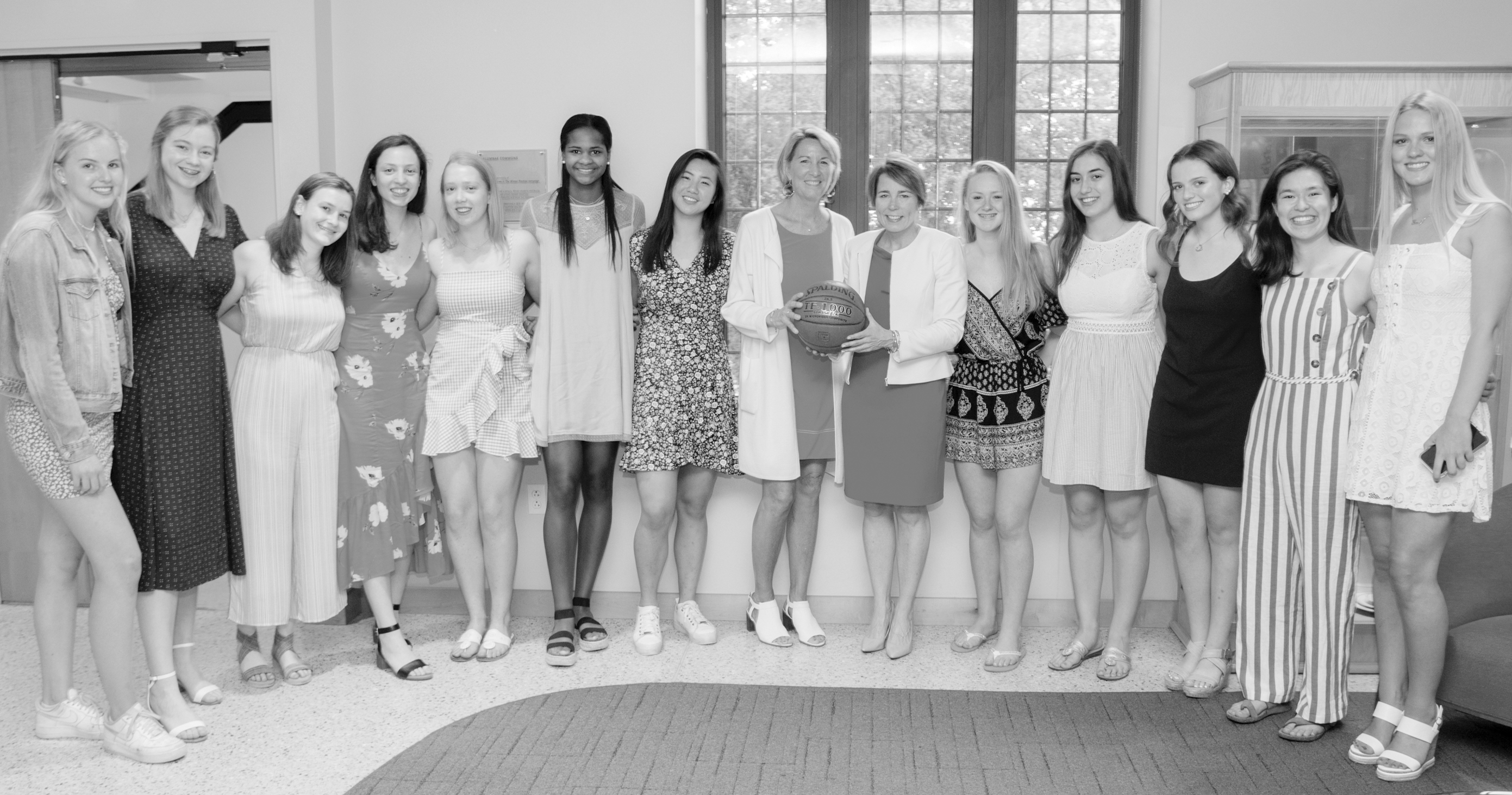
Governor and 2019 Commencement Speaker Maura Healey with Students Photo from Aleksaundra Handrinos
The Massachusetts Ballot Questions tackled a diverse array of issues, from economic measures to education initiatives to drug regulation. The first question asked voters whether they would allow the State Auditor to audit the Massachusetts legislature and received a significant majority in favor, showing strong support for more stringent checks and balances despite some concerns that the new law would interfere with the separation of powers. The second question, on removing the MCAS test as a high school graduation requirement, was likewise passed. Supporters argued that the testing requirement was a poor assessment of student knowledge and wrongly incentivized teachers to teach to the test, while critics contended that mandatory testing was essential to maintaining education standards and assessing teacher efficacy. Passing by 54%, the third ballot question allowed ride-share drivers—like Uber and Lyft employees—to form labor unions. This measure aims to secure more equitable pay for drivers while risking increased consumer costs. The fourth question, on legalizing certain psychedelic substances, was not passed, with many voters concerned about the lack of regulatory frameworks and the potential for abuse despite possible therapeutic benefits. Finally, the fifth question, on raising the minimum wage for tipped workers, was voted down.
Amelia Kwak ’25 noted she was “initially surprised by question five because I had thought that raising the minimum wage for tipped workers would be good for servers, but after speaking with servers I learned that the majority of them did not, in fact, want question five to pass.” Her insight highlights an important aspect of the ballot questions when considering the issues that impact Massachusetts: talking directly to voters can provide a substantial amount of new information about the impact of an issue on day-to-day lives.☐
 Winsor Banner