
By the Lower School Newspaper Club |
Current Lower School students are all well aware of artificial intelligence (AI) as the majority of students use it in their daily lives. As the years pass, AI progressively grows in popularity, making it a common topic of discussion in Lower School classrooms and hallways.
Many Lower School students think of AI in a more negative way, and as a resource that must be used responsibly. Several Class I and II students noted that AI can be untrustworthy. Yolanda Yu ’32 states, “AI is made by humans, so it’s obviously going to have a lot of biases, and sometimes that is very harmful to certain groups of people.” Students also raised concerns over the potential misinformation that AI spreads. Yu explains, “AI is not always going to be an entirely reliable source because of the fact it is not always based on credible sources.”
Despite these worries, various Lower Schoolers do agree that AI can be a helpful resource if used properly, specifically for academic purposes and answering everyday questions. Most Lower Schoolers believe that if fact-checked and based on correct sources, AI can be used as long as it’s only for explaining a challenging problem or helping students study. Some Lower Schoolers also use AI to ask everyday questions, such as Aleena Fereja ’32, who says, “I would use it for daily needs… like something I would [ask] Google.” Trisha Dumervil ’32 adds, “I would ask [AI] about everyday life stuff, like recipes.”
English Faculty member Mr. Crompton believes that “AI can be super helpful for personalized brainstorming. The best AIs are incentivized to find results that work for YOU in ways that traditional search engines simply aren’t. This personalized approach often offers a pathway into engaging in the learning process more fully. In a broader sense, I think AI is best used as an accordion-style thought partner. If I have a really narrow idea, AI can expand the possibilities and scope of that idea. If I have a really broad set of disparate thoughts, AI can help distill those thoughts into a workable path forward. In a school setting, I think we can use this narrowing and expanding aspect of AI to help plan multi-step, long-term projects, as well as to get us going when we’re stuck in a sea of endless options.” He noted that while he also uses artificial intelligence occasionally for questions and brainstorming, “[s]imply having AI produce things for you, in a school setting, is a recipe for short-term and long-term disaster. For example, having AI write anything for you both robs you of the opportunity to practice writing and creates a dependency on outsourced writing for the future.”
Although Mr. Crompton is concerned with the academic problems with AI and Class Is and IIs are apprehensive about the biases surrounding AI, Class IIIs and IVs are more concerned about the environmental effects of AI use. For months, news articles and social media posts concerning the large amounts of water used to build and operate AI data centers have circulated around Winsor, opening conversations about the benefits versus the disadvantages of generative AI. When asked about her concerns on AI’s water use, Eden Tierney ’31 reflected, “There should be more information about AI and the environment because I think a lot of people think, ‘Oh, this chatbot’s just gonna create [something] and there will be no side effects.’”
Many Lower Schoolers echo Eden’s concerns, resulting in their outright refusal to use AI. However, others do not restrict their AI use entirely, as it is becoming increasingly difficult to avoid AI when using the internet. Although using AI when completing school work raises concerns about academic integrity, students like Alice Gorman ’30 highlight the differences between asking AI “to do stuff for me” versus asking it “to help me.” The distinction between asking AI to complete tasks and using it as a tool to aid learning is crucial as all humans, but particularly students, learn how to navigate this new age of AI.
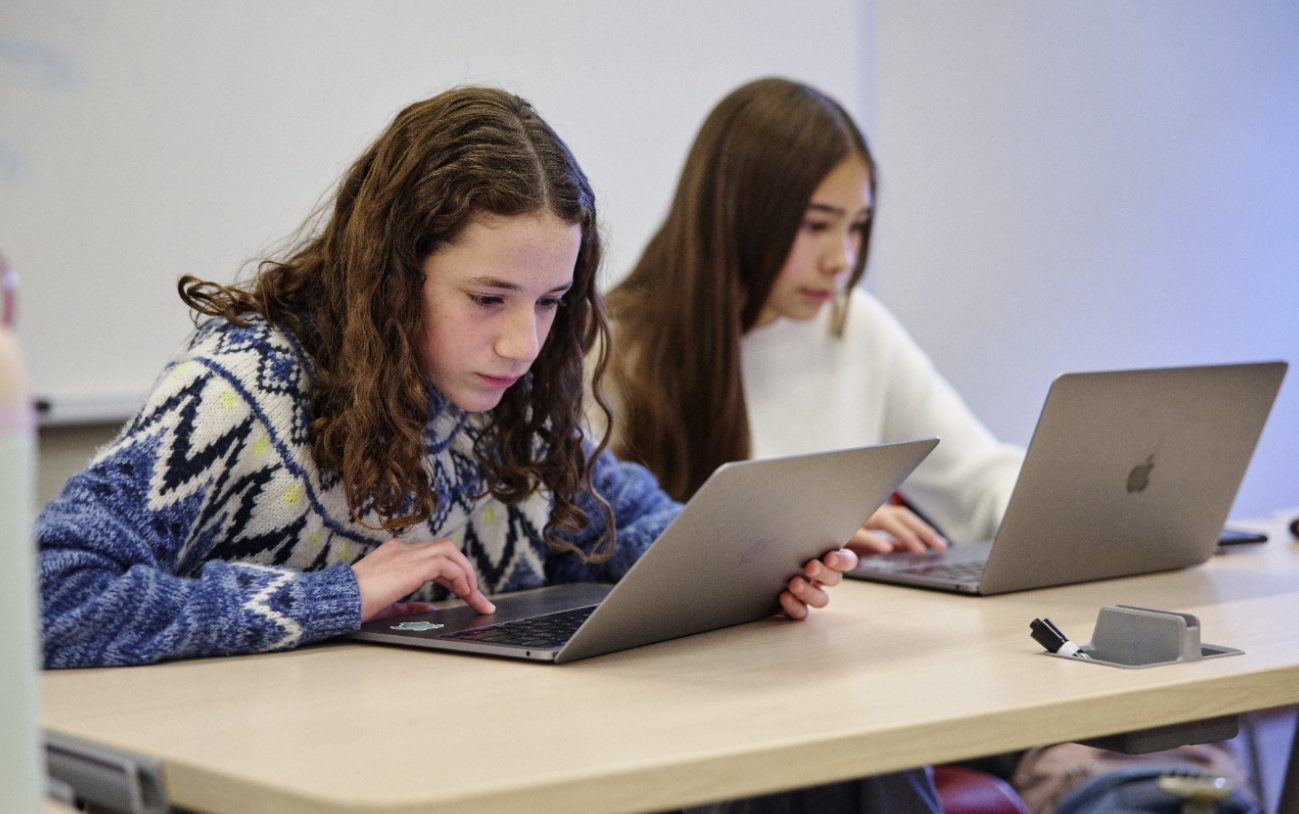
Image Source: Lower School Student Photographer

