
By Elyse Hychong, Banner Staff
In early January, multiple fires of varying sizes broke out in Los Angeles. The largest of these fires were the Palisades and Eaton fires: the Palisades Fire burned 23,707 acres in the Pacific Palisades, destroying 6,800 structures, while the Eaton Fire burned 14,021 acres in Altadena and Pasadena, resulting in the destruction of 9,400 structures. According to the Los Angeles Times, the wildfires have led to at least 29 fatalities as of February 2025.
While the causes of the fires remain unknown, one factor was the weather conditions: The New York Times reported that Los Angeles was extremely dry and there were hurricane-force winds, both of which heightened the risk of fire. PBS News noted that another factor was an equipment mishap, with Southern California Edison power lines in Eaton Canyon possibly helping to spark the Eaton fire.
The Eaton wildfires also significantly impacted the Black community. Research from UCLA’s Ralph J. Bunche Center for African American Studies found that Black households account for nearly one-fifth of the total households in Altadena, and the LA Times explained that the destruction thus “takes a heavy toll on the historically Black community of Altadena, where many families of color had used their homes to accumulate generational wealth.”
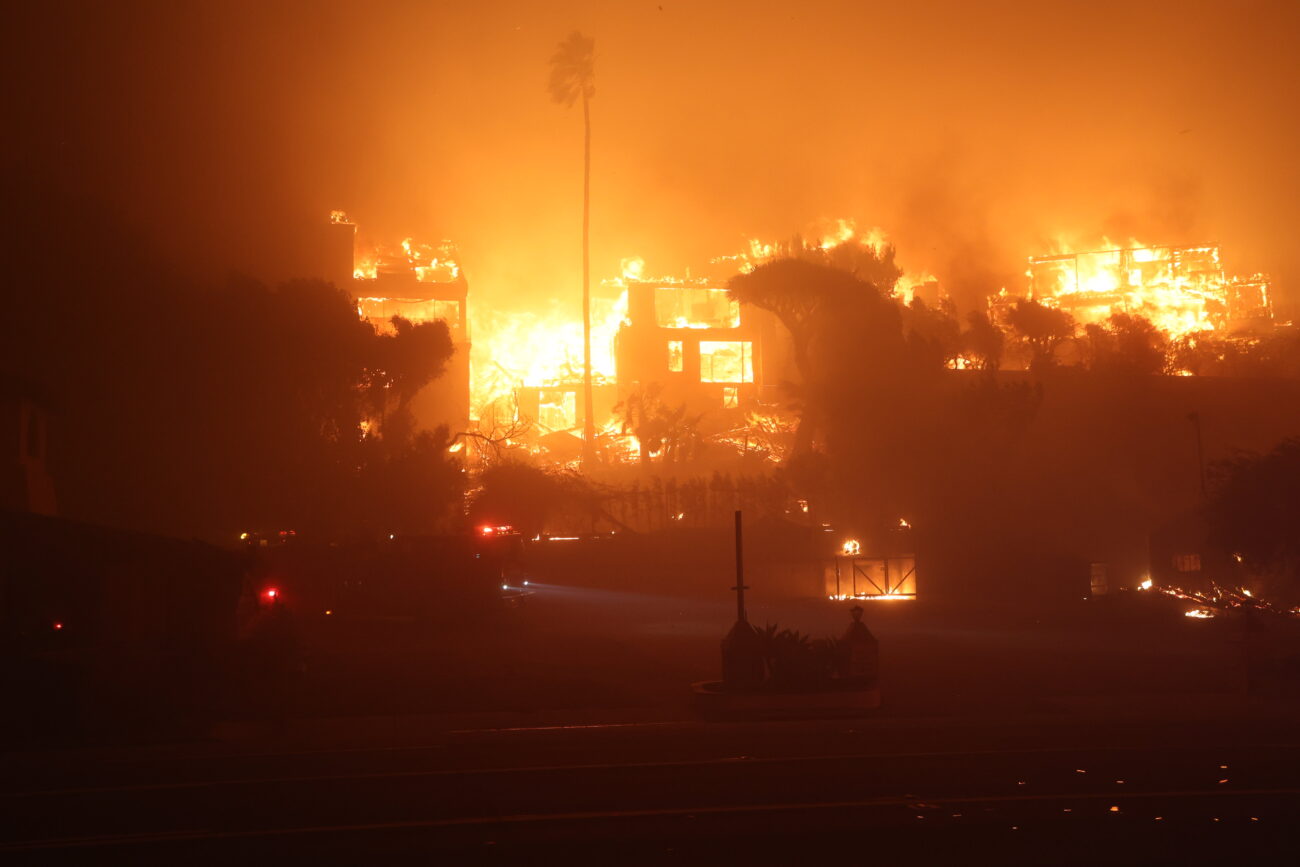
The Palisades Fire on January 8, The Columbia Climate School
Youjin Choi ’26 was born in Los Angeles and reflected, “I lived in LA until I was around eight, so a lot of the destruction shown on social media is of places I knew. I saw a Reel showing the remains of the Malibu area where I used to go all the time as a kid, so seeing places I recognized in such a dystopian light is really devastating.” Indeed, the LA wildfires are more than numbers or statistics; they are representative of very real and deeply devastating experiences.
As the city turns towards rebuilding, several questions arise. First, should LA rebuild in the same way, or should it rebuild with a stronger focus on architecture that can withstand wildfires and other extreme weather events? The city must put in place reinforcements to prevent future wildfires, but as writer Abe Streep noted in a recent piece for New York Magazine’s Intelligencer, “doing so would require persuading the Palisades’s wealthiest to live differently… It would require difficult conversations with members of the Black community who have fought, over generations, for a place to flourish.”
Moreover, The New York Times writers Adam Nagourney and Shawn Hubler emphasized in a recent article that there is no centralized chief in the Los Angeles recovery effort, with four separate independent rebuilding committees all claiming leadership: civic leader Steve Soboroff, billionaire developer Rick Caruso, Governor Gavin Newsom, and Los Angeles Times owner Patrick Soon-Shiong. As a result, it is unclear how the recovery efforts will be divided and what actions will be taken in the future.
Rebuilding may be affected by President Trump’s new immigration policies. According to the National Association of Home Builders, 41% of construction workers in California are immigrants, meaning construction is dependent on migrant workers. Because Trump’s policies now encourage the deportation of immigration violators, there may be a shortage of construction workers to rebuild the city.
Overall, the LA wildfires have been devastating to both LA’s physical environment and those who inhabit it. As the city moves towards rebuilding, there continues to be uncertainty about recovery and the future, and The Banner wishes all the best to the people navigating these difficult times.

