
By Nina Gersen, Banner Staff
As a child, my favorite activity was reading. Before I had a cell phone or homework to do after school, I would go home and read a book. I remember sitting on the floor of my fourth grade classroom while my teacher read Charlotte’s Web aloud to our class, listening with my siblings to the audiobooks of the Percy Jackson series, and picking out new books from the library. Aoife Keane ’27, an avid reader, shared, “Reading as a kid helped me learn and experience so much that I would otherwise not have. It was one of my favorite things to do.” During childhood, reading is extremely impactful in shaping creativity and imagination.
However, young kids today do not have the same opportunities to experience the joys of reading. The American Library Association (ALA) reports that between January 1 and August 3, 2024, there were 414 attempts to censor books and other library materials, and in these attempts, 1,128 different titles have been targeted for censorship. The ALA defines an attempt to censor a book as any instance where one, or in many cases, multiple books are challenged or banned “based upon the objections of a person or group.” Since 2020, the number of efforts to ban books in the United States has rapidly increased. Ms. Duncan, the director of the Virginia Wing Library, laments these statistics: “Most of those materials tend to be about LGBTQ+ issues, or about Black voices and advocacy, or other things that people developed a strange sensitivity about. These books tend to be books that are critically acclaimed, but then make people uncomfortable.”
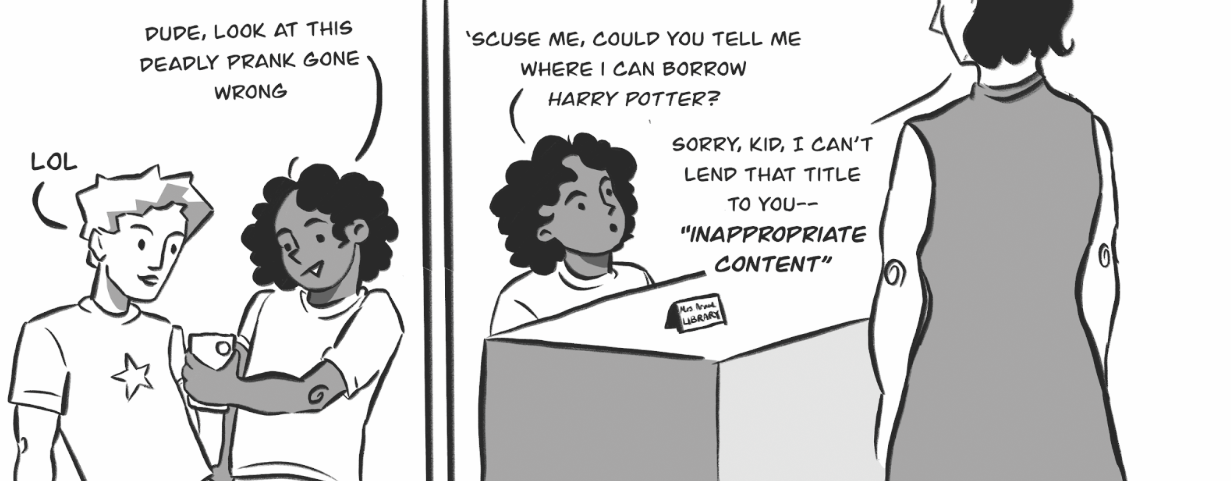
Irony of Banning Books, Bella Holt
Many books currently being banned are considered “classics” for middle-grade readers, so it is possible that children will not be able to enjoy these iconic and distinguished stories. Harry Potter has been banned in many states for “depicting witchcraft.” In Florida, Percy Jackson was banned for the same reason, as well as for depicting homosexuality. Even Charlotte’s Web, one of the most popular and prominent middle-grade books, has been banned in some states for depicting talking animals.
Banning books that expose children to new and unfamiliar topics not only shelters them from truly understanding the complexity of the world but inhibits kids from developing active imaginations and individuality. Yes, some topics in books are not appropriate for middle-grade readers, but instead of having restrictions on all children’s access to books across the country, parents should decide what their children can and cannot read.
Banning these books does not only censor content: it prevents kids from reading stories that will encourage them to use their imaginations. When these kids grow up, we will see the effect of book bans. If they cannot imagine a world that is different from their own, they will never be able to imagine a world that is better than their own, and they will never be able to make positive change in the world.

